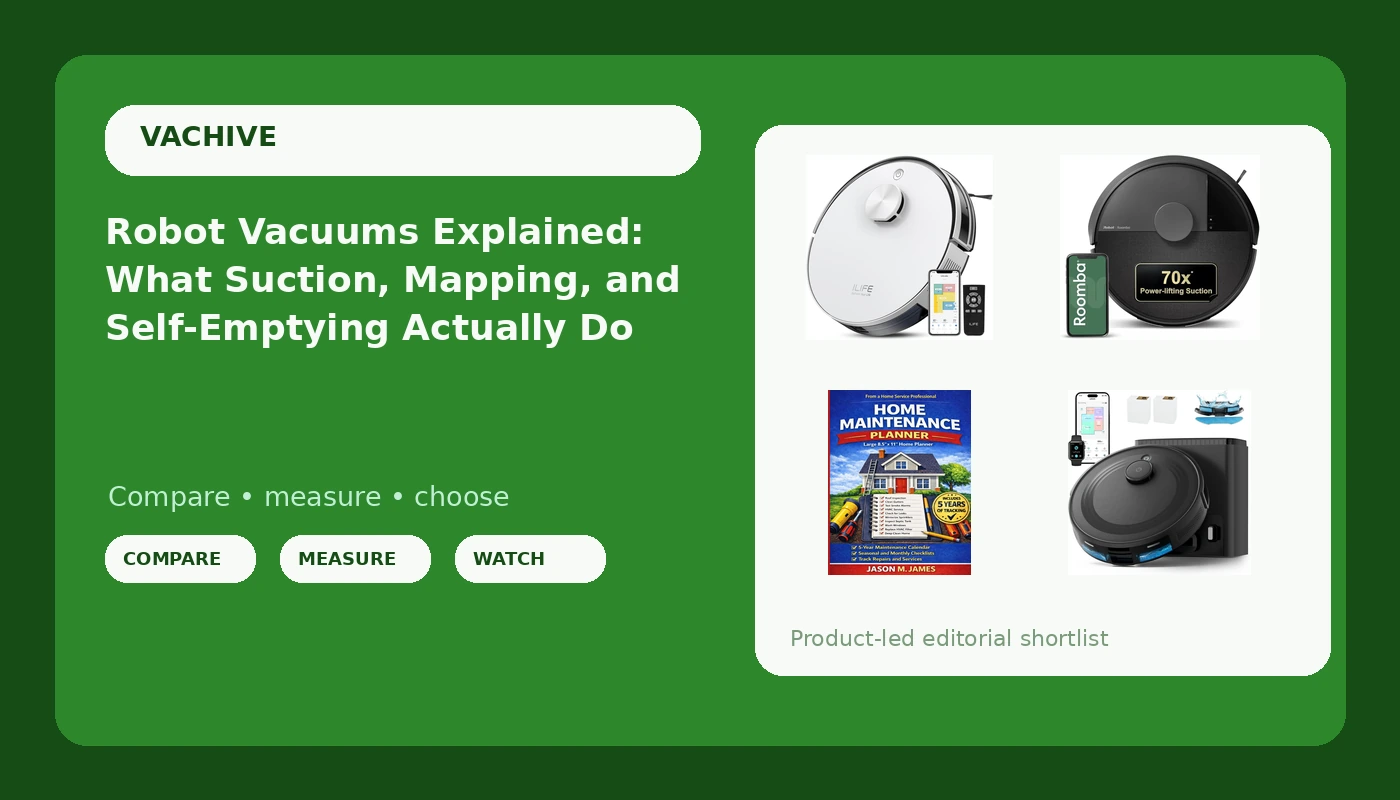
A robot vacuum is the rare appliance that promises to remove work from your week and then quietly adds a different chore: managing the machine. Most of the confusion in this category comes from three specs that get marketed as if they were the whole story, suction measured in pascals, mapping technology, and whether the dock empties itself. None of those numbers tells you whether the robot will survive your rug transitions, your pet hair, or your habit of forgetting the bin for a week. This robot vacuum buying guide walks through what each feature actually changes at home, where the four options below fit, and how to decide without paying for a capability you will never use.
Related: Robot Vacuum Maintenance: The Weekly Routine That Keeps Suction Strong →
Quick answer
Buy for your floor plan and your habits, not for the largest number on the box. If your home is mostly hard flooring and you already empty a bin without being reminded, a simpler high-suction vacuum such as the ILIFE A30s covers the daily job. If you have pets or kids and want the robot to learn rooms and clean them on command, mapping matters more than raw pascals, which is where the iRobot Roomba 105X fits. If you know you will not empty a bin every day, a self-emptying dock like the Lefant M2 Plus removes that step entirely. And if the deeper problem is that you never think about your house until something breaks, a seasonal maintenance logbook is the cheapest tool in this group. Check current Amazon price on any of these before you commit, because pricing moves.
4 useful options
| Model | Best fit | What stands out |
|---|---|---|
| ILIFE A30s Robot Vacuum, 10000Pa Max Suction | Apartments and small homes with mostly hard floors | High listed max suction in a simple, single-unit package |
| iRobot Roomba 105X Robot Vacuum, Smart LiDAR Mapping, 70X Power‑Lifting Suction, Custom Room Cleaning, App & Voice Control, Auto Recharge, Great for Homes with Pets & Kids | Multi-room homes with pets and kids | LiDAR mapping, custom room cleaning, app and voice control, auto recharge |
| The Ultimate Home Maintenance Checklist and Logbook for Homeowners: An Easy Seasonal Guide to Keep Your Home Running Smoothly and Avoid Expensive Repairs | Owners who want a written seasonal upkeep schedule | Printed seasonal checklist and logbook format |
| Lefant Robot Vacuum and Mop Combo,75-Days Self-Emptying,6000Pa Powerful Suction,Multi Floor Mapping, No-Go Zones,140 Min Runtime,2.4G/5G WiFi/Alexa/APP/iWatch, M2 Plus Black | Homes that want vacuuming and mopping from one dock | 75-day self-emptying, multi-floor mapping, no-go zones, 140 minute listed runtime |
The daily runner: ILIFE A30s Robot Vacuum, 10000Pa Max Suction
The trade-off here is routine, not capability. Without a dock, every run ends with you handling the bin, and the bin is the honest scoreboard for any robot. If you empty it daily and it fills with grit, hair, and fine dust, the machine is doing real work. If it fills with fluff and a few visible crumbs, the brush head is not sealing against your floor and extra pascals will not fix that. The A30s makes the most sense for someone with a smaller footprint, mostly hard surfaces, and a habit of emptying a bin without being nagged. If your home has three rug transitions and two long-haired pets, read the next two entries before you decide.
The pet-and-kid pick: iRobot Roomba 105X Robot Vacuum
Mapping is the feature that changes your relationship with the robot, but only when it is stable. A floor plan you can name and reuse means weekday kitchen runs and weekend bedroom runs, and it means the robot resumes instead of restarting when the battery dips. The failure mode to watch for is a map that resets after every firmware update, which turns custom room cleaning into a chore of its own. This is the option to weigh when the mess in your house is generated by things that move: pets, kids, and the crumbs that follow them.
The maintenance companion: The Ultimate Home Maintenance Checklist and Logbook for Homeowners
A robot vacuum is one line item in a house that needs attention in dozens of places: filters, gutters, seals, and the small leaks that become large ones. The connection is not sentimental. Every appliance you add to a home adds maintenance, and maintenance that lives only in your head gets skipped. A logbook gives the robot's filter changes and brush cleanings a home alongside the water heater flush and the seasonal exterior walk. If you already keep a spreadsheet, you do not need this. If you have ever discovered a problem only after it got expensive, this is the least costly item in the group and the one that outlasts the hardware.
The self-emptying pick: Lefant Robot Vacuum and Mop Combo, M2 Plus Black
Self-emptying is the feature that decides whether a robot runs daily or weekly, because it removes the single most common reason people stop using one. A dock that seals debris into a bag also keeps dust out of the air when it empties, which matters in homes with allergies. The trade-offs are real: a dock takes floor space, needs its own bag supply, and adds one more component that can fail. Mopping combos also have limits. They are designed for light surface maintenance, not for scrubbing dried spills, and a pad that stays wet too long can leave streaks. Treat the mop as a maintenance pass between real mopping, not a replacement for it.
Prices and availability may change. Product images, names, and retailer links must be matched by verified ASIN. Do not state a current price, rating, stock status, or measured result without current evidence.
What a suction rating does and does not tell you
Suction is measured in pascals, and the number on the box is typically the maximum the motor can produce under controlled conditions, not what reaches your floor on a Tuesday afternoon. What actually reaches the floor depends on the seal between the brush head and the surface, the airflow path, and how full the bin and filter already are. A vacuum listed at 10000Pa with a clogged filter can move less air than a 6000Pa unit with a clean one. That is not a reason to ignore the number. It is a reason to treat it as a ceiling rather than a promise.
The bin is the honest scoreboard. After a scheduled run, the bin should hold grit, hair, and fine dust pulled from the floor. If it holds mostly fluff and a few visible crumbs, the robot is grazing the surface rather than cleaning it, and more pascals will not fix a brush head that cannot seal against your flooring. High-pile carpet is the hardest test, because the brush has to sink in before airflow can lift anything out. Low-pile rugs and hard floors are far more forgiving, which is why a simpler machine can outperform an expensive one in the right house.
Two other numbers matter as much as suction. Runtime determines how much square footage the robot can cover before it returns to charge, and the Lefant M2 Plus lists 140 minutes, a long single pass. Bin capacity determines how often you intervene. A robot that covers your whole main floor but fills its bin in one run is a robot you will resent by week two, which is the practical argument for a self-emptying dock.
Mapping, no-go zones, and what the dock changes
Mapping is the part of this category that sounds like magic and behaves like software. A robot with LiDAR mapping builds a floor plan and can then clean room by room, which matters if you want the kitchen on weekdays and the bedrooms on weekends. The Roomba 105X lists smart LiDAR mapping and custom room cleaning, which is the useful version of the feature: you name rooms and send the robot to them.
No-go zones apply the same idea to avoidance. You draw a rectangle around a dog bowl, a tangle of charging cables, or a rug you would rather not have vacuumed, and the robot stays out. The catch is that zones live inside the map, so anything that resets the map resets your zones. If a robot rediscovers the house on every run, the feature is decorative. Before you buy, ask whether the app keeps its map through updates, because that single behavior decides whether mapping is a tool or a toy.
A self-emptying dock changes your routine more than any app feature. Instead of emptying a bin after every run, the dock pulls debris into a sealed bag. The Lefant M2 Plus lists 75 days of self-emptying, which converts a daily task into a quarterly one. That is the difference between a robot that runs every day and a robot that runs when you remember.
- Measure your largest uninterrupted floor area and compare it against the listed runtime.
- Check the lip height of every rug transition the robot will cross.
- Count the cords, pet bowls, and drop zones that need a no-go zone.
- Decide honestly whether you will empty a bin daily or want a dock to do it for you.
- Choose the robot that matches those answers rather than the biggest suction number.
Keeping a robot vacuum useful after the first month
- Empty or dock the bin on a schedule you will actually keep. Daily is ideal, and a self-emptying dock exists precisely because daily is hard.
- Clear the brush roll every week. Hair wraps around the roller, reduces the seal, and quietly cuts suction long before the bin looks full.
- Wash or replace the filter on the manufacturer's interval. A clogged filter is the most common reason a working robot stops picking up grit.
- Do a cord and cable sweep before the first run in any new room. Obstacle sensors are good, not perfect, and a chewed charging cable is an expensive lesson.
- Re-check your map and no-go zones after every firmware update, and re-draw them the moment a room stops being cleaned properly.
- Log the maintenance. Filter changes, brush cleanings, and bag replacements belong on the same schedule as the rest of your home upkeep, which is exactly what a seasonal logbook is for.
Which option should you choose?
Choose the ILIFE A30s Robot Vacuum, 10000Pa Max Suction when your home is mostly hard flooring, your floor plan is compact enough for one run, and you will empty a bin without being reminded. Choose the iRobot Roomba 105X Robot Vacuum when you have multiple rooms, pets or kids, and you want the robot to learn the layout and clean specific rooms on command. Choose the Lefant Robot Vacuum and Mop Combo, M2 Plus Black when you want vacuuming and light mopping from a single dock and you know you will not empty a bin daily. Choose The Ultimate Home Maintenance Checklist and Logbook for Homeowners when the real gap is that your home has no written upkeep schedule at all.
One caveat applies to all four. Listed specs describe what the manufacturer designed the product to do, and they are the fairest basis for comparison before purchase. They are not a guarantee of how any unit will behave in your specific house, on your specific rugs, with your specific pets. Confirm current details on the product page, and judge the robot by what ends up in the bin after a week of scheduled runs.
The bottom line
The right robot vacuum is the one that runs every day without you thinking about it, and every feature in this category is really an argument about which step you are willing to keep doing. Suction handles the floor. Mapping handles the floor plan. A self-emptying dock handles your memory. A logbook handles everything else in the house. Match the machine to the chore you will not skip, confirm the current details before you buy, and expect to maintain whichever one you choose. That expectation, more than any spec sheet, is what separates a robot that still works in two years from one sitting in a closet.