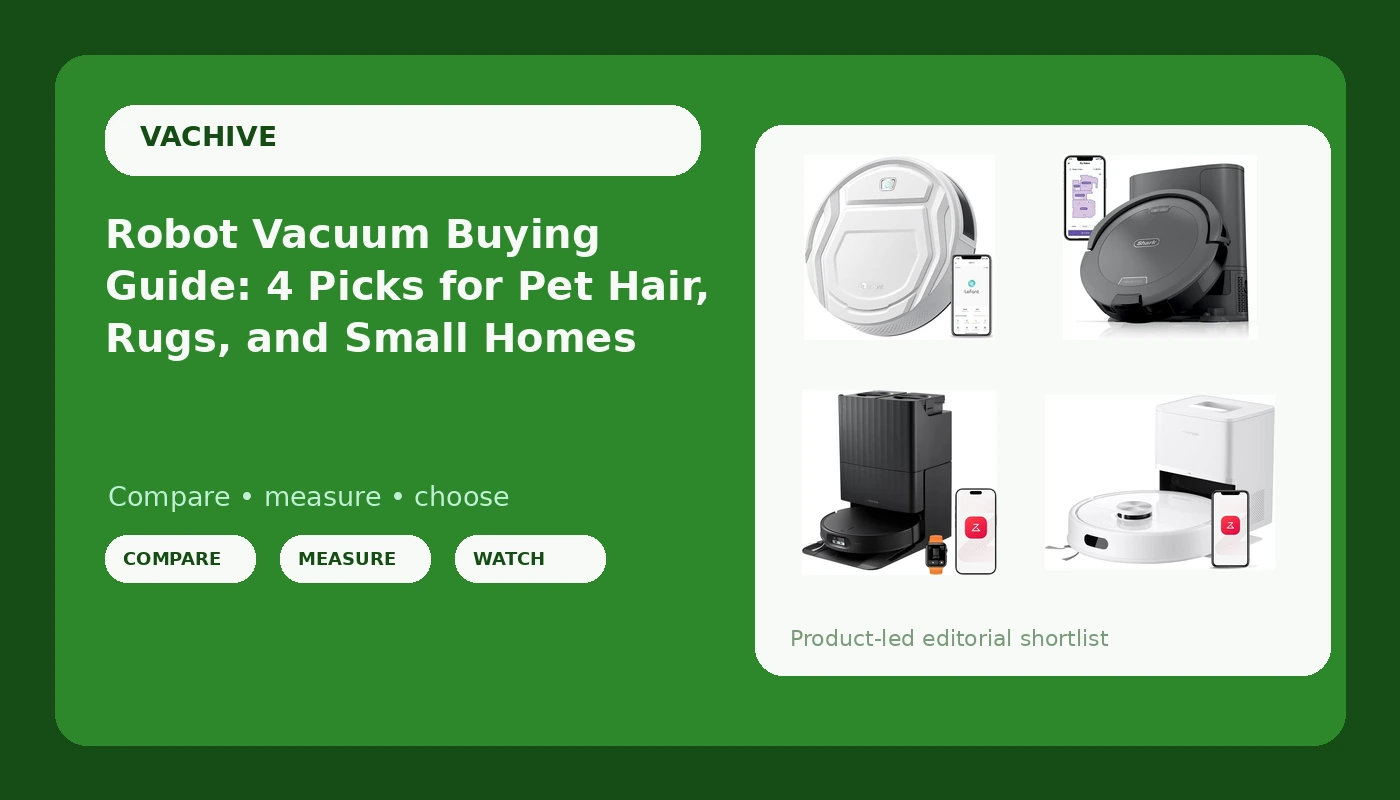
A robot vacuum either earns its floor space or it becomes an expensive doorstop with a schedule. I clean houses for a living, and the units that survive past month two are almost never the ones with the biggest number printed on the box. They are the ones that cross a rug lip without stalling, that have a bin you can empty without hunting for a screwdriver, and that remember the floor plan after a firmware update.
That is the lens I use when a client asks me to help them choose a robot vacuum for pet hair, hard floors, and a house that is not one open rectangle. The four machines below sit at genuinely different points on the capability ladder, and each one fits a specific kind of home. Two of them solve problems the others do not solve at all, and one of them makes sense mainly because it does less.
Related: Self-Emptying Robot Vacuum Docks: How They Actually Work →
Quick answer
Buy for the floor plan and for your willingness to maintain the machine, not for the largest figure in the listing. The Lefant M210 fits small homes with mostly hard floors and no interest in a dock. The Shark Navigator RV2120AE adds a self-empty base in the mid range. The roborock Qrevo Edge 2 combines high listed suction with mopping in an ultra-slim body. The renewed roborock Q7 M5+ pairs a long self-empty interval with an anti-tangle brush system aimed at pet hair and carpet. If you have shedding pets and wall-to-wall carpet, the self-emptying units justify their extra cost. If you have 600 square feet and no rugs, they mostly add maintenance you did not ask for.
Four useful options
| Model | Best fit | What stands out |
|---|---|---|
| Lefant M210 | Small apartments, hard floors, tight budgets | Slim body, listed 120-minute runtime, app and Alexa control, no dock to buy |
| Shark Navigator RV2120AE | Mid-range buyers who want the bin handled for them | Ships with a self-empty base, vacuum-first design |
| roborock Qrevo Edge 2 | Homes that want vacuuming and mopping in one pass | Listed 25,000Pa suction, 3.14 inch ultra-slim chassis, vacuum and mop in one unit |
| roborock Q7 M5+ (Renewed) | Pet hair and carpet with weeks between bin empties | Listed 10,000Pa suction, dual anti-tangle system, LiDAR navigation, up to 7 to 9 weeks self-empty |
Budget pick: Lefant Robot Vacuum Cleaner M210
The trade-off is honest and predictable: no dock means you empty the dust cup yourself, and a compact robot with a small cup fills quickly in a shedding household. The listing positions it for pet hair, hard floors, and daily cleaning, which is exactly the context where a dock-free robot works. Put it on thick carpet with a heavy shedder and you will be emptying it constantly. Put it in a one-bedroom with tile and a cat, and it can run every morning without you thinking about it.
Mid-range self-emptying: Shark Navigator Robot Vacuum RV2120AE
Self-emptying changes the daily habit more than any suction number does. Instead of flipping a dust cup over a trash can every morning, you pull a sealed bag out of the dock every few weeks. That is the whole pitch, and for a lot of homes it is the difference between a robot that runs daily and one that gets unplugged in week three.
The catch is that a dock is not self-maintenance. You still clear hair from the brush roll, wipe the sensors and charging contacts, and buy replacement bags. A dock also needs floor space and a nearby outlet, which rules it out in some closets and narrow hallways.
Premium vacuum and mop: roborock Qrevo Edge 2
Mopping is where expectations need calibrating. A robot mop maintains a floor that is already reasonably clean; it does not scrub dried spills off grout, and it does not replace a mop and bucket on a kitchen that gets real cooking traffic. What it does well is take the daily film of dust and paw prints off hard floors so your own mopping is a weekly job instead of a daily one. You also take on a water tank and a pad, both of which need attention if you want the mopping half to stay worth using.
Pet hair and carpet with self-empty: roborock Q7 M5+ (Renewed)
The renewed label is the part to read carefully. A renewed unit has been through someone else's hands before yours, so condition, included accessories, and warranty coverage depend on the specific seller listing rather than on the model itself. That can mean real savings on a self-emptying machine, and it can also mean a dock that arrives without a bag or a robot with cosmetic wear. Check the condition notes and the warranty terms before you commit, and treat the listed self-empty interval as a best case measured on light debris, not on a house with two shedding dogs.
Prices and availability may change. Product images, names, and retailer links must be matched by verified ASIN. Do not state a current price, rating, stock status, or measured result without current evidence.
What actually decides whether a robot vacuum gets used
The single best predictor of whether a robot survives in a home is not suction. It is the emptying habit. A robot with a dock gets emptied by the dock, so the human job drops to a bag change every few weeks. A robot without a dock gets emptied by a person, and every person has a threshold where that chore stops happening. In small homes with hard floors and light debris, that threshold is rarely crossed. In homes with pets, carpet, and kids, it gets crossed fast.
The second predictor is floor transitions. A robot that stalls on the lip between a hard floor and a rug will strand itself there, and you will find it dead in a doorway with a half-full bin. Before you buy anything, walk your floors and look for the obstacles that actually exist: thick rug edges, thresholds between rooms, chair legs, floor lamps, charging cables, and pet bowls. Robots navigate the house you have, not the house in the marketing photos.
The third is mapping reliability. A robot that rediscovers the floor plan on every run is not a smart robot, it is a random one with a nicer app. LiDAR navigation, like the PreciSense system listed on the Q7 M5+, is the approach that tends to hold a map steady, which matters if you rely on scheduled runs and no-go zones. If your no-go zones have to be redrawn after every update, the schedule stops being trustworthy and you stop trusting the machine.
How to read the spec sheet without getting fooled
Suction ratings are the least comparable number on any listing. The 25,000Pa figure on the Qrevo Edge 2 and the 10,000Pa figure on the Q7 M5+ describe how hard each machine pulls air at the inlet, not how much debris ends up in the bin after a run. A high number with a clogged filter or a hair-wrapped brush performs worse than a modest number with a clean path. Use the rating to sort machines into rough tiers, then stop paying attention to it.
Runtime and self-empty intervals are both best-case figures. A listed 120-minute runtime assumes a mostly hard floor and a moderate cleaning mode; carpet and high suction modes burn through a battery faster. A listed self-empty interval of up to 7 to 9 weeks assumes the bin is not packed with pet hair on day three. Neither number is a lie, but both describe an easy week.
Mopping claims need the same skepticism. A robot mop that drags a damp pad across a floor is maintaining a surface, not deep cleaning it. Budget mop combos have a habit of smearing mess around rather than lifting it, which is why I would rather see a household buy a strong vacuum-only robot and keep their own mop than buy a cheap two-in-one that does both jobs badly.
Finally, check what "renewed" means for the specific listing. Renewed units can be excellent value, especially on self-emptying models where the dock is the expensive half of the package. They can also arrive with a shorter warranty or a missing accessory. Read the condition description the way you would read a used car listing.
Matching a robot to your home, step by step
- Count your rugs and measure the tallest edge. Any lip over roughly half an inch is a genuine obstacle for a low-clearance robot.
- Estimate how often you will realistically empty a bin by hand. If the answer is "not daily," you want a self-empty dock.
- List your floor types. Mostly hard floor favors a slim vacuum-first robot; carpet and pet hair favor an anti-tangle brush system.
- Decide whether you want mopping in the same machine. If yes, accept the tank and pad routine as part of the deal.
- Walk the floor for cables, thresholds, and tight furniture gaps, then pick the machine whose body and navigation can handle what you found.
Keeping a robot vacuum useful after week one
- Empty the bin or swap the dock bag on a fixed schedule, before the robot starts leaving streaks.
- Clear the brush roll weekly in pet homes, and cut wrapped hair rather than pulling it.
- Wipe the sensors, camera, and charging contacts so the robot can find its dock.
- Get charging cables off the floor, since they are the most common thing a robot eats.
- Run it on a schedule you will actually maintain, and check the app after firmware updates to confirm the map and schedule survived.
Which option should you choose?
Choose the Lefant M210 when you have a small home with mostly hard floors and no interest in a dock, and you are comfortable emptying a compact bin yourself. Choose the Shark Navigator RV2120AE when you want the bin handled automatically and you want to stay in the mid range with a vacuum-first machine. Choose the roborock Qrevo Edge 2 when you want strong listed suction, mopping in the same pass, and a body slim enough to get under low furniture. Choose the roborock Q7 M5+ (Renewed) when pet hair and carpet are the main event and you want a long gap between bin empties, with the understanding that a renewed unit's condition and warranty depend on the seller.
One caveat applies to all four: the figures in this article come from the product listings, not from measurements I took in your house or mine. Every home has a different mix of floor types, thresholds, and shedding volume, and those variables move performance more than any spec on the box.
The bottom line
The right robot vacuum is the one that runs without you negotiating with it. In a small, hard-floor home, the Lefant M210 keeps that bargain simple because there is no dock to place, no bag to buy, and no mopping routine to abandon. In a home with pets and carpet, the math flips: the self-emptying roborock Q7 M5+ and the Shark Navigator RV2120AE both remove the daily bin chore, and the Q7 M5+ adds an anti-tangle brush system built for the hair that causes most robot breakdowns. The roborock Qrevo Edge 2 is the pick when you want the highest listed suction in this group plus mopping and an ultra-slim chassis, as long as you accept that a robot mop maintains a floor rather than deep cleaning it. Match the machine to your floors and your habits, and it will keep them at good enough that your own cleaning is a weekly job instead of a daily one.