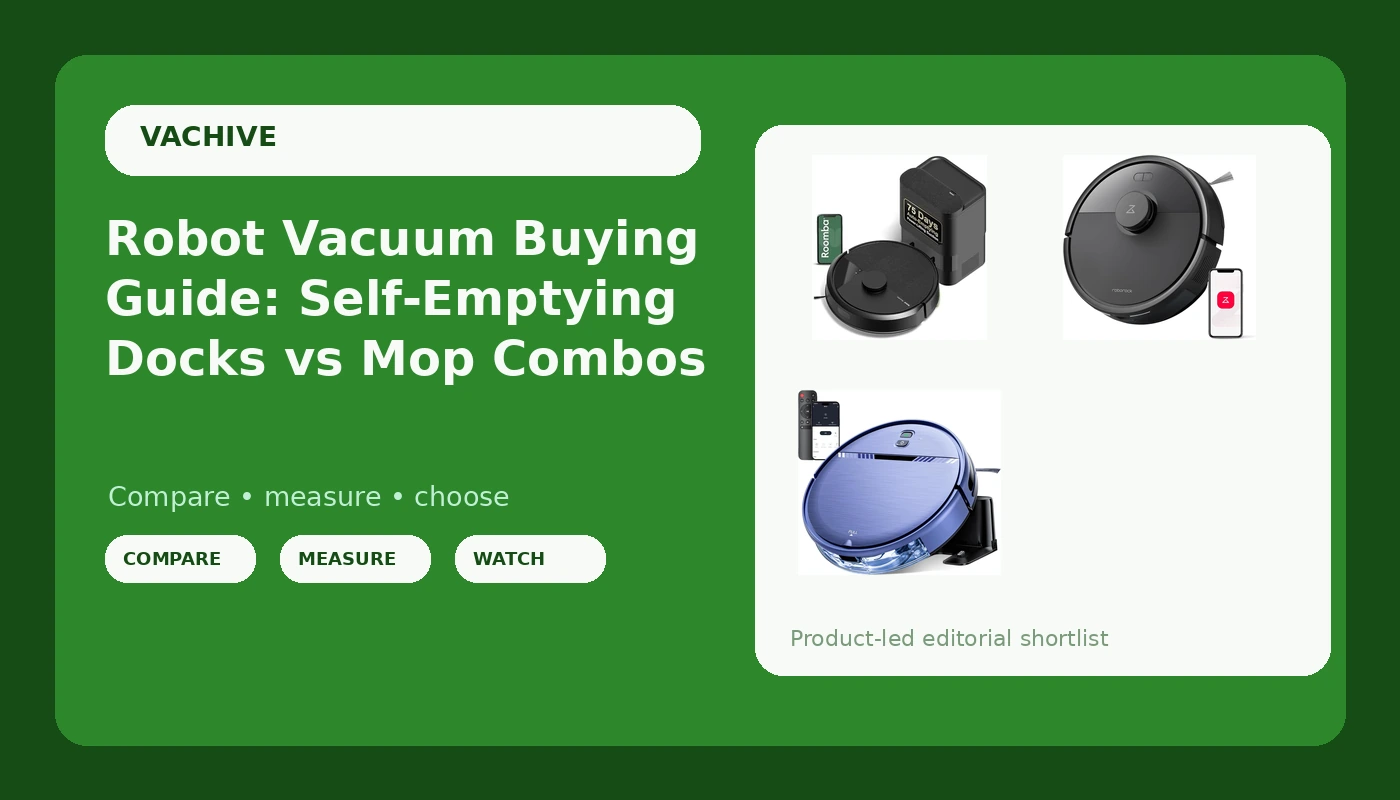
If you have spent an evening comparing robot vacuums, you know the pattern. Every listing promises strong suction, smart navigation, and app control, and almost none of them answer the question that actually decides whether you will still be using the thing in two months: what does this machine ask of me every week? This robot vacuum buying guide looks at three specific models that sit at three different points on the same spectrum, so you can match the hardware to your floor plan instead of to a spec sheet.
The three options here are a vacuum with a self-emptying dock, a vacuum and mop combo with a high suction rating, and a straightforward 2-in-1 combo aimed at hard floors and low-pile carpet. None of them is a maid. Each one can hold your floors at a decent baseline, but only if you pick the one whose maintenance routine you will actually follow.
Related: Robot Vacuum Maintenance: The Weekly Habits That Keep It Running →
Quick answer
If your priority is touching the machine as little as possible, the iRobot Roomba 105 Vac with its AutoEmpty dock is the one to look at first, because the dock handles bin emptying for you and the listing describes it as self-emptying for 75 days. If you want suction plus a mopping pass in a single unit, look at the roborock Q7 L5, which is rated at 8,000Pa of suction. If you want the simplest route into combo cleaning with voice assistant support and scheduling, look at the iMartine Robot Vacuum and Mop Combo.
One expectation to set now: the mopping on both combos is a light maintenance pass for dust and everyday film, not a substitute for a real mop when something sticky hits the floor.
Three useful options
| Model | Best fit | What stands out |
|---|---|---|
| iRobot Roomba 105 Vac Robot Vacuum with AutoEmpty Dock | Homes where nobody wants to touch a dustbin | AutoEmpty dock, self-empties for 75 days, LiDAR navigation, multi-surface cleaning, neat row pattern |
| roborock Q7 L5 Robot Vacuum and Mop Combo, 8,000Pa Suction | Floors that need suction plus a light mop pass | Vacuum and mop combo with 8,000Pa rated suction |
| iMartine Robot Vacuum and Mop Combo | Apartments and single-floor homes with hard floors and low-pile carpet | 2-in-1 dust box and water tank, Alexa and Google Assistant support, long runtime, scheduling, quiet operation |
Self-emptying dock option: iRobot Roomba 105 Vac
The trade-off is footprint and commitment. A self-emptying dock needs a permanent wall outlet and a patch of floor that stays clear, which is a real constraint in a small apartment and a non-issue in a house with a mudroom or utility corner. You are also buying into dock bags as a recurring consumable, and the dock makes a noticeable noise burst when it transfers debris. What you get in return is the removal of the bin-emptying step, and in my experience that step is where daily routines go to die. If you have pets or a household with allergies, the difference between a robot that runs every day and one that runs when someone remembers is the whole ballgame. This model does not mop, so if you want a wet pass, look at the two combos below.
High-suction combo option: roborock Q7 L5
Here is the honest caveat about suction numbers: pascal ratings are not measured the same way by every brand, so 8,000Pa is not directly comparable to a competitor's 8,000Pa, and it certainly is not a promise about what lands in your bin. What a high rating usually reflects is a stronger motor and a more aggressive airflow claim, which tends to matter most on low-pile carpet and on hard floors with grit. On plush or high-pile carpet, no robot in this class is going to dig down to the base of the fibers, and a full-size upright still earns its place. The mopping side of a combo like this is a drag-behind damp pad, which is good for dust, light kitchen film, and paw prints, and not good for dried spills. Think of it as maintenance, not deep cleaning.
Everyday combo option: iMartine Robot Vacuum and Mop Combo
The appeal here is simplicity and price of entry. A 2-in-1 dust box and water tank means one module to remove and rinse instead of two separate tanks, and voice assistant support plus scheduling means you can start a run without opening an app. The listing does not specify a lidar mapping system, so do not expect the room-by-room mapping and permanent no-go zones that a lidar machine offers; expect a simpler navigation approach and plan your floor accordingly. The stated suction is described as strong rather than given as a number, and the intended surfaces are hard floors and low-pile carpet, which is exactly where a machine like this is most useful. If your home is mostly tile, laminate, or vinyl with a couple of flat rugs, this is a sensible starting point. If you have thick carpet, multiple pets, or a two-story layout, the limitations will show up faster.
Prices and availability may change. Product images, names, and retailer links must be matched by verified ASIN. Do not state a current price, rating, stock status, or measured result without current evidence.
How a self-emptying dock changes the maintenance math
Every robot vacuum has the same weak point, and it is not suction. It is the bin. A robot with a small onboard bin fills up quickly in a home with pets, and the moment the bin is full, the machine stops being useful even though it keeps running. That is why so many robot vacuums end up parked in a closet by month three: the owner missed a few days of emptying, the performance dropped, and the habit broke.
A self-emptying dock solves that specific failure mode. The robot returns to the dock, the dock pulls the contents of the onboard bin into a larger sealed bag, and the robot goes back to work on its next schedule. The Roomba 105 listing describes 75 days of self-emptying, which is a manufacturer figure that assumes typical debris volume; a home with three shedding dogs will not get 75 days out of any bag. Treat that number as a ceiling, not a promise.
What the dock does not eliminate:
- Filter maintenance. Filters still load up with fine dust and still need to be tapped out or replaced on schedule.
- Brush and roller cleaning. Hair wraps around rollers regardless of who empties the bin.
- Edge and corner work. No dock helps a robot reach a baseboard better.
- Dock bag replacement. The bag is a consumable, and it is the cost you accept in exchange for not handling dust.
If you have allergies, the sealed-bag transfer is the feature that matters most, because you are not tipping a bin over a trash can and releasing a dust cloud into the room. If you have a small apartment and no pets, the dock is convenience rather than necessity, and a simpler machine with a manually emptied bin can do the same daily job.
What suction ratings and mop hardware actually tell you
Suction is the most marketed and least standardized number in this category. An 8,000Pa rating tells you the manufacturer's own measurement, not how the machine performs on your carpet. Two things matter more in practice: whether the robot seals against the floor well enough to build airflow at the nozzle, and whether it passes over the same spot more than once. A machine with a neat row pattern and a slower, overlapping route will often leave a cleaner floor than a faster machine with a bigger number on the box.
For the mopping side, there are two broad designs in this price range. A 2-in-1 dust box and water tank, like the iMartine, keeps everything in one module you remove and rinse. A separate-tank combo, like the roborock Q7 L5, generally gives you more water capacity and lets you leave the mopping hardware off when you only want to vacuum. Neither design scrubs. Both drag a damp pad or cloth across the floor. That is enough for dust, light kitchen film, and paw prints, and not enough for dried cereal.
Surfaces decide more than specs do. Hard flooring, meaning tile, laminate, vinyl, and sealed wood, is where any of these machines look impressive. Low-pile and flat-weave rugs are fine. Plush and high-pile carpet is where robots in this class struggle, and where you should lower expectations and keep a full-size vacuum for a weekly pass.
A simple way to choose:
- Measure the areas you want covered and note where the rugs are, including the height of each rug edge. A lip the robot cannot climb becomes a wall.
- Decide honestly whether you will empty a bin every day or two. If the answer is no, prioritize the self-emptying dock.
- Separate your floors into hard surface and carpet, then decide whether you want a wet pass at all. If you never mop, a vacuum-only machine is the simpler buy.
- Walk the floor at the robot's height. Cords, charging cables, sock edges, pet bowls, and floor lamp bases are the obstacles that end runs early.
- Pick a run time and put it on a schedule you will keep, then plan the maintenance tasks around it: filter, roller, sensors, and water tank.
Practical guidance before you buy
- Run the robot daily rather than in long weekly marathons. Short, frequent passes keep the bin from overfilling and keep the floor at a consistent baseline.
- Give the dock a permanent spot on hard floor with clearance on both sides. Docks that get shoved around or blocked are docks the robot cannot find.
- Do a cord sweep before the first run and after any furniture rearrangement. Charging cables are the most common casualty.
- Empty and rinse the water tank after every mopping run, and let it dry open. Standing water grows a smell quickly.
- Replace filters on the manufacturer's interval and clean hair off the roller weekly. Most "my robot got weaker" complaints are a loaded filter or a wrapped roller.
- Read the app once, set the schedule, then leave it alone. Rebuilding a map after every firmware update is a known annoyance across brands.
Which option should you choose?
Choose the iRobot Roomba 105 Vac Robot Vacuum with AutoEmpty Dock when you want the machine to handle its own bin and you are willing to give up mopping and dedicate a permanent dock corner. Choose the roborock Q7 L5 Robot Vacuum and Mop Combo, 8,000Pa Suction when you want one unit that vacuums and runs a damp pass, and you have a mix of hard floors and low-pile carpet. Choose the iMartine Robot Vacuum and Mop Combo when your home is mostly hard flooring with flat rugs, you want scheduling and voice control, and you would rather spend less and accept simpler navigation.
One caveat on evidence: the features above come from the manufacturers' own product listings, not from independent lab testing. Suction ratings, self-emptying intervals, and runtime figures are all manufacturer claims measured under conditions you may not replicate at home. No coverage here should be read as a measurement, and no current price or rating is stated because those change constantly.
The bottom line
The right robot vacuum is the one whose maintenance routine you will actually keep. If bin emptying is the step that breaks your habit, pay for the self-emptying dock. If you want one machine to vacuum and give hard floors a light damp pass, a combo like the roborock Q7 L5 fits that job. If you want the simplest and least expensive entry into combo cleaning on hard floors and low-pile carpet, the iMartine covers that ground with scheduling and voice assistant support. Whichever you pick, budget for filters, rollers, and a five-minute weekly maintenance check, because that is what separates a robot that works for years from one that ends up in a closet.