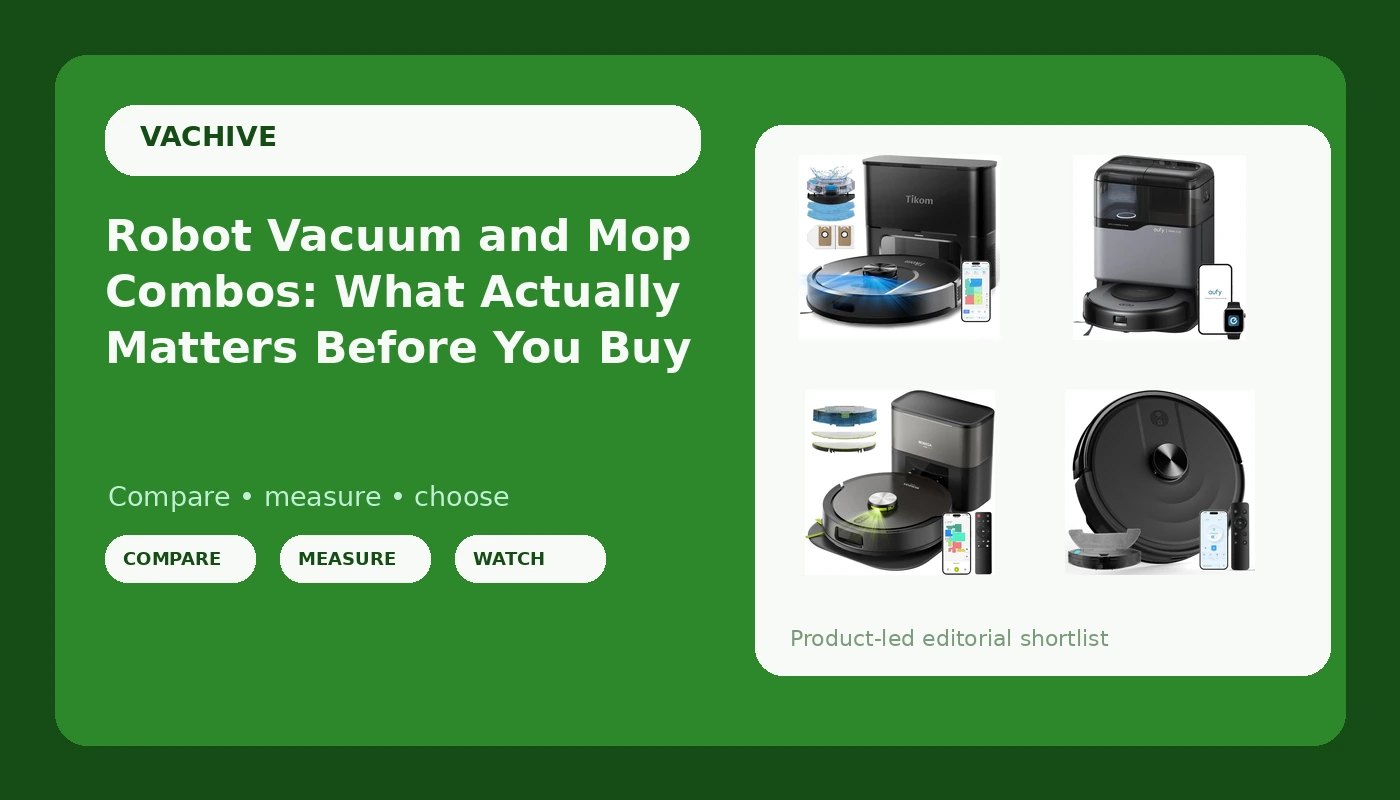
I have cleaned floors for a living for nine years, and I have watched a robot vacuum and mop combo succeed or fail in almost every floor plan you can describe: 4,000 square foot houses with three rug transitions per room, 600 square foot apartments with two cats, and rentals where every charging cord lives on the floor. The pattern repeats. The dock decides how often the machine actually runs. The navigation decides whether you trust it in a room unsupervised. And the dustbin, not the spec sheet, tells you whether it picked up real dirt or just fluff. Below I compare four currently listed robot vacuum and mop combos, the Tikom self-emptying unit, the eufy Omni C20, the MONSGA 90 day self-emptying model, and the Bagotte LiDAR combo, and explain what each one is actually built around.
Related: How to Keep a Robot Vacuum From Eating Charging Cords →
Quick answer
None of these four is universally the right pick, because each one solves a different problem. If a self-emptying dock is the feature you care about, the Tikom Robot Vacuum and Mop is the unit in this group built around a self-emptying base. If you want the highest suction rating here alongside a well-established brand name behind the app and the spare parts, the eufy Omni C20 lists 7,000 Pa. If the longest advertised gap between bin changes is what you are after, the MONSGA Robot Vacuum and Mop advertises 90 days of self-emptying with an 8000Pa suction rating. If mapping, app control, and voice control matter more than a dock, the Bagotte Robot Vacuum and Mop Combo pairs LiDAR navigation with 2.4G WiFi, app, Alexa, and remote control. Choose the dock behavior and the navigation you can live with first, then let suction ratings break the tie.
Four useful options
| Model | Best fit | What stands out |
|---|---|---|
| Tikom Robot Vacuum and Mop, Robotic Vacuum Cleaner with Self-Emptying Base | Homes where hand-emptying a bin is the chore you want gone | Self-emptying base combined with vacuum and mop function |
| eufy Omni C20 Robot Vacuum and Mop Combo for Hardwood and Carpet, 7,000 Pa | Mixed hard floor and carpet homes that want a familiar brand | 7,000 Pa suction rating and a combo design for hardwood and carpet |
| MONSGA Robot Vacuum and Mop, 90 Days Self-Emptying with 8000Pa Suction | Households that want the dock to hold debris for a long stretch | Advertised 90-day self-emptying and an 8000Pa suction rating |
| Bagotte Robot Vacuum and Mop Combo, 6000Pa with Mapping, LiDAR Navigation | Multi-room homes that want mapping and voice control | LiDAR navigation with mapping, auto-recharging, and 2.4G WiFi, app, Alexa, or remote control |
The self-emptying option: Tikom Robot Vacuum and Mop, Robotic Vacuum Cleaner with Self-Emptying Base
The trade-off with any self-emptying base is footprint and upkeep. The dock occupies a permanent patch of floor with clearance on both sides, and it introduces bags or a canister as a consumable you have to keep stocked. Self-emptying also does not mean maintenance-free: filters, brushes, and the mop pad still need attention on a schedule, and a jammed dock can stop a run before it starts. If you want the dock to do the boring part and you are willing to give it real estate, this is the role it fills.
The high-suction, established-brand option: eufy Omni C20 Robot Vacuum and Mop Combo for Hardwood and Carpet, 7,000 Pa
What the listing does not describe is a self-emptying base, so plan on emptying the robot bin by hand. For some homes that is fine, especially if you already run a robot daily and the bin is part of your routine. For a shedding dog or a long-haired household, hand emptying is the step people skip, and a skipped step is how a robot ends up parked in a closet. The other thing to weigh is carpet: a combo that mops and vacuums needs to lift or avoid the mop pad on rugs, and how well that works varies by model and by pile height. Check the current listing details for the mop behavior on carpet before you commit.
The long-interval self-emptying option: MONSGA Robot Vacuum and Mop, 90 Days Self-Emptying with 8000Pa Suction
Treat the 90-day figure as a manufacturer claim tied to typical use, not a guarantee for your house. A single heavy-shedding dog can fill a dock bag far faster than a two-person apartment with hard floors, and fine drywall dust or tracked-in sand compresses differently than pet hair. Before buying, confirm that replacement bags or the dock canister are easy to find, because a self-emptying dock with no consumables available becomes a manual bin with extra steps. The 8000Pa rating is also worth reading in context rather than as a scoreboard number, which I get into below.
The mapping and voice control option: Bagotte Robot Vacuum and Mop Combo, 6000Pa with Mapping, LiDAR Navigation
This is the unit in the group where navigation is the headline and the dock is not mentioned, so plan on manual emptying. LiDAR mapping is the more useful half of that trade for multi-room homes, because a robot that knows the layout can run room by room instead of wandering. Two practical notes: the listing specifies 2.4G WiFi, so a router that broadcasts only a 5 GHz band will not connect, and no-go zones and saved maps are exactly the features that tend to reset after a firmware update. Set up the map once, confirm it survives an update, and you will know what you own.
Prices and availability may change. Product images, names, and retailer links must be matched by verified ASIN. Do not state a current price, rating, stock status, or measured result without current evidence.
How a self-emptying base changes the maintenance math
A self-emptying base is a dock with a vacuum of its own. When the robot finishes a run, it returns to the dock, and the dock pulls the contents of the robot bin into a larger bag or sealed canister. The benefit is not suction. The benefit is that the smallest, most annoying container in the whole system, the robot's own bin, stops being something you touch every day.
That changes behavior more than it changes cleaning. A robot with a small bin and no dock collects for one or two rooms and then needs a human. A robot with a dock can finish a whole floor and come back full, and the debris sits sealed until you deal with the larger container on a slower schedule. The catch is that the slower schedule is a claim, not a promise. Advertised intervals like 90 days assume a particular amount of debris per run. A household with two cats, a dog, and a gravel driveway will hit the real limit long before that, and the honest metric is how fast the dock fills, not how many days the box promised.
There are also two maintenance realities worth planning for. First, the dock needs floor space and clearance, and it needs to be somewhere the robot can reach without fighting a doorway. Second, a self-emptying dock adds consumables, usually bags, and a dock that jams will strand the robot with a full bin. Emptying a dock canister or swapping a bag is still maintenance, just less frequent maintenance.
What suction ratings and navigation specs actually tell you
Suction ratings measured in Pa describe pressure, not cleaning. A 6000Pa unit, a 7,000Pa unit, and an 8000Pa unit are not separated by a dramatic real-world gap on hard floors, where airflow and brush design do most of the work. On carpet, the difference between models has more to do with how the brush roll sits against the pile and how the robot handles the transition at the rug edge than with the number on the box. Suction figures are useful for comparing units that are otherwise similar. They are not useful as a ranking system on their own.
Navigation is the spec that decides whether you trust the machine. LiDAR uses a spinning laser to build a map of the room, which is why LiDAR units tend to handle multi-room layouts and dark rooms more predictably. Camera-based navigation can work well, but it depends on light and on software quality. Either way, the features that matter day to day are whether the map persists between runs, whether no-go zones stay where you drew them, and whether the app survives an update without forgetting your schedule.
Then there is the part no spec sheet captures: rug transitions. A robot that stalls on a half-inch lip will strand itself at the same spot every run, and you will find it there with a half-full bin and a dead battery. If your home has thick rugs or a raised threshold, that single behavior outweighs every other number in this article.
- Measure the dock location first, including clearance on both sides and a path the robot can actually reach.
- Count your rug transitions and note the lip height on each one, because that is where robots strand themselves.
- Decide which bin-emptying habit you will actually keep, daily hand emptying or a slower dock schedule.
- Decide whether saved maps and no-go zones matter in your layout, and whether you need voice control.
- Check your WiFi band, since 2.4G-only devices will not join a 5 GHz-only network.
Keeping any of these running
- Run the robot on a schedule rather than on demand, because a robot that runs daily keeps floors at a manageable baseline.
- Empty or swap the dock container on a fixed day of the week so it never becomes an emergency.
- Clear charging cords, pet toys, and loose rugs before the first run in a new room, not after.
- Rinse or replace the mop pad after mopping, since a damp pad left on the dock is a smell waiting to happen.
- Check the brush roll for hair monthly, because a wrapped brush roll quietly reduces pickup on carpet.
- Recheck your saved map after any firmware update, and redraw no-go zones if they shifted.
Which option should you choose?
Choose the Tikom Robot Vacuum and Mop when you want a self-emptying base and the dock is the feature you are buying. Choose the eufy Omni C20 when you have a mix of hardwood and carpet, want the 7,000 Pa suction rating, and value an established brand for app and parts support. Choose the MONSGA Robot Vacuum and Mop when the longest advertised self-emptying interval and the highest suction rating in this group are the priorities, and you have confirmed the dock consumables are available. Choose the Bagotte Robot Vacuum and Mop Combo when mapping, app control, Alexa, and remote control matter more than a dock, and your home network runs 2.4G WiFi.
One caveat applies to all four. The details here come from the manufacturer listings, including suction ratings, the 90-day self-emptying claim, and the navigation type. I have not published measured results for these specific units, and advertised intervals depend heavily on how much debris your home generates. Verify the current listing, the return window, and the consumables before you buy.
The bottom line
A robot vacuum and mop combo is a maintenance tool, not a maid. It keeps floors at a baseline so you do less, and it does that only if it runs often enough and if the bin situation fits your habits. Match the machine to the chore you will actually do: a self-emptying dock if emptying is the step you skip, LiDAR mapping if you have rooms to cover and want it done in order, and a suction rating that fits your flooring rather than the biggest number on the page. Check current Amazon price on each of the four, confirm the dock or the bin routine works for your home, and buy the one whose weakness you can live with.